No, I’m Pretty Sure I Rank Higher

If a sentence begins, “Well, at least YOU…” you can bet your sweet bippy that it is a comparison that aims to show the speaker in greater need or pain than the listener.

“Well, at least YOU know some of the people at the party. I don’t know anyone.”

“Well, at least YOU have a job to complain about. I can’t even find work.”

“Well, at least YOU have a kid who tries to get good grades. I can’t get mine to care.”

 

star winner2


You get the idea. There are some people who always seem to need to rank higher on any “scale” of life being discussed. Kristen Wiig’s Penelope character from Saturday Night Live is the queen of “one-upping”:


YOU WILL HAVE TO CLICK ON THIS LINK TO SEE THE VERY FUNNY VIDEO OF PENELOPE BECAUSE NBC AND WORDPRESS ARE MAKING MY LIFE DIFFICULT.


Most of us are not Penelopes. (Thank God!) But I think it’s safe to say that most of us have been guilty of occasionally one-upping someone—even another’s pain. For whatever reason, we sometimes feel the need to have our own situation acknowledged as primary. Maybe it’s rooted in the frustration of feeling unheard, but…no matter what…it’s annoying. And it’s super annoying when it’s about another’s pain or loss.

Within the year after my dad died from his battle with cancer, another family suffered the loss of a husband and father in a car accident. My mother was friends with the new widow, and she offered her comfort in her time of loss. I will never forget the woman’s response. She said, “Well at least you were able to say goodbye. You knew your husband was dying, and you had that time with him. I didn’t. Mine was gone in an instant.”

You know in cartoons how sometimes a character gets hit or mowed down and then they get up and try to briskly shake off the effects? That was my mom. She eventually replied, “Yes, I did have that time to say goodbye. But I also saw him suffering for months, and I wouldn’t wish that on anyone.”

I remember sitting there and wondering what the point was of this “grief contest” that the widow created. Both women lost their spouses. One got to say goodbye. The other didn’t. One’s husband suffered at length. The other’s husband was gone in a flash. Was there a prize for greater loss?

It was unfortunate that what should have been two people coming together in pain that they each understood all too well instead became a “Oh, yeah? Well, my grief is greater” conversation.

Clearly the widow was hurting and trying to make sense of things, so we have to put the conversation in that context and give her grace, but…it really stuck with me.

Clinical psychologist Susan Silk created the “ring theory” to illustrate a simple way for people to know how to avoid saying the wrong thing to someone going through a crisis. It’s completely common sense, but we are not always led by common sense now, are we?


ring theory
(Illustration by Wes Bausmith…)


In a nutshell, comfort moves toward the center (the person in crisis or pain), and any kind of comparing or complaining can only be shared with someone in a larger ring.

This theory allows for the widow of my story to say whatever because of the loss she is suffering, but since my mom was in the same boat, they were pretty much together in the same ring.

It’s not rocket science to understand that you shouldn’t tell someone who just lost a job that your boss is a real d-bag, but…sometimes we do.

Or if someone is sharing with you that they feel a certain way to cut in and say, “oh, yeah, me too! For me it’s like…” but…sometimes we do.

Or if someone is going through something as horrific as the loss of a child to say that we understand that loss because we’ve lost a parent…but…sometimes we do.

We are so very human, but we need to fight the urge to chime in and one-up one another.

We all know our own struggles best. After all, we are the ones going through them. It makes sense that we would feel most intensely about them. But that’s how it is for everyone.

Very often the ideal response to someone going through a challenge or crisis is so very, very simple: Listen. Listen so well that they feel heard.

It is so simple that sometimes it feels like it’s not enough. I need to do something. I need to help them or give them advice. But it is often perfectly enough. And if it’s not, the person will probably let you know.

Listen so that they know what they are saying matters to you. That they matter to you. It’s pretty impossible to say the wrong thing listening. The whole being quiet thing really reduces your chances of doing so.

Listening is a practice that is ongoing with every person and every situation. It’s never the same twice. But it always matters.

Want to rank high at something? Be an amazing listener.

At least that’s what I heard.


All photos are my own or have been used with attribution.
Please note that there may be advertisements below via WordPress.com.
The presence of these ads does not constitute endorsement of the information, services, or products found in them.

10 Great Reasons to Forgive

I took my mom to the bank drive thru the other day. I think these mainly still exist for people in my mom’s generation—though having the little canister get sucked up into the tube is pretty cool. The transaction turned out to be very frustrating because the tellers didn’t see something they should have and ended up treating us rather poorly.

My mom was…ticked. She wanted me to get the teller’s name and complain. I told her to take a breath and let it go. We have bigger fish to fry. But it took her a while to get past it. (Actually, I think given the chance, she’d still give the teller an earful.)

I know I can be guilty of the very same kind of misspent energy, and I bet you can admit to the same. While forgiving little slights isn’t too hard, there are times where it’s just easier to steam at the injustice.

And then there are the bigger fish that do indeed need frying. The kinds of hurts that make it even harder to let go and offer forgiveness.

But no matter how big or small the “fish,” we should always strive to forgive, and here are my ten great reasons why…

  1. God commands us to. As a Christian, I have the greatest model of this in Jesus…who offers forgiveness even to the very people who crucified him. What a powerful example of practicing what you preach. Other major religions—Buddhism, Islam, Hinduism, Judaism—also teach forgiveness. With nearly six billion people in the world identifying with a religion, we should be awash in forgiveness.
  1. We need it every day. At least I do—and I’m pretty sure you do, too. So if we need it but choose not to offer it to others who need it, then we need to strap on our hypocrisy hats.


bridge


  1. We benefit from offering forgiveness to others. Receiving forgiveness is obviously awesome, but I have had some significant experiences in my life of offering forgiveness, and the healing that comes from it—both spiritually and emotionally—is powerful and freeing.
  1. We lose negative and gain positive energy. Not only is the impact of forgiveness spiritual and emotional, but it can be physical, too. There are times when I have forgiven someone and felt an immediate physical change—as though weighty scales have fallen off of me and tangibly lightened my being. These times have served to remind me how damaging it is to hold onto negative energy. Positive rocks. Negative sucks.


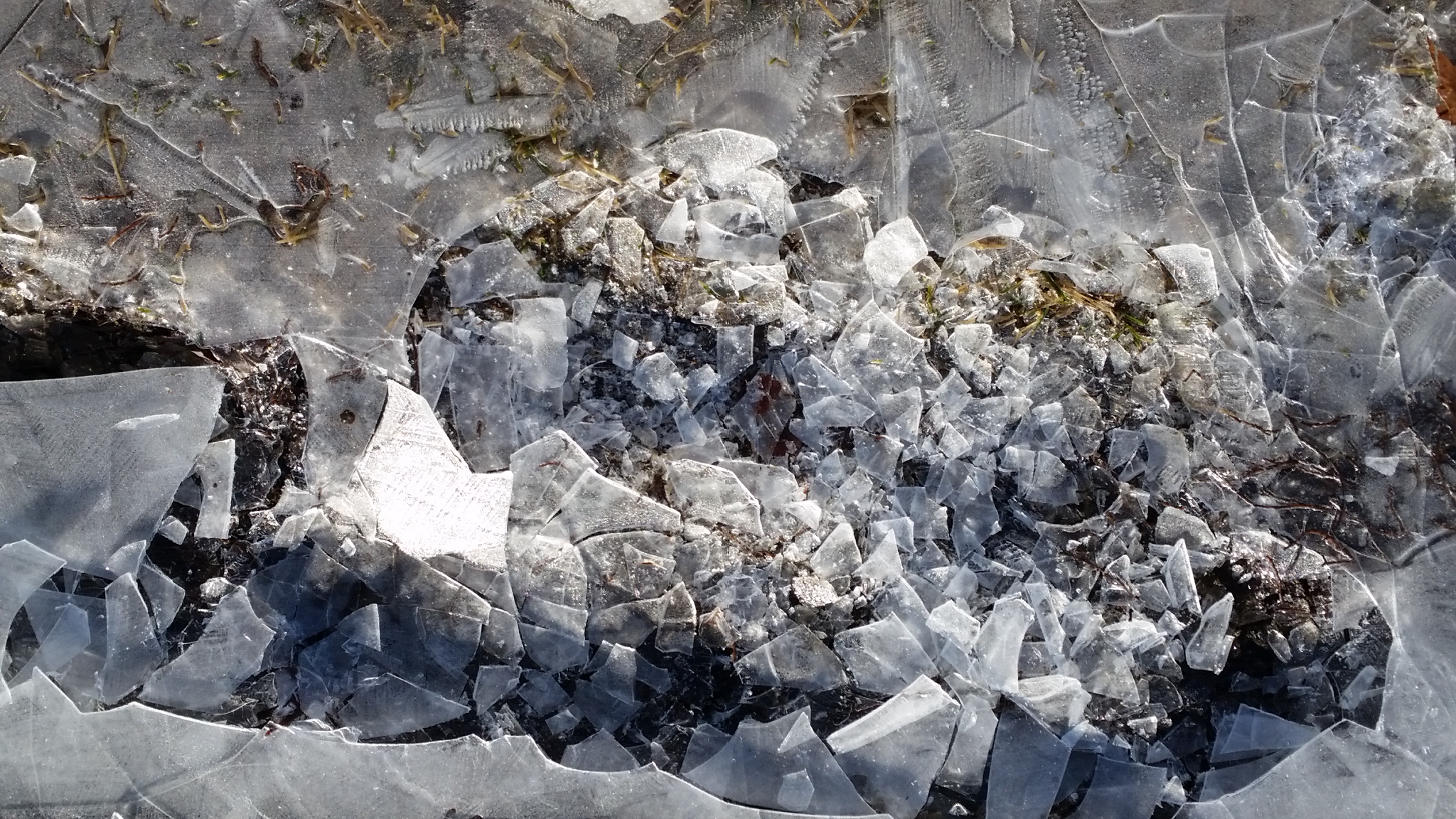
ice zags


  1. It helps others. We know how amazing it feels to be forgiven. The grace and mercy that comes our way is transformative. Why wouldn’t we want to facilitate that amazingness for others? Share the wealth.
  1. In withholding forgiveness, we can suffer more than the one whom we believe needs it. Sometimes the hurt you’re feeling may not even be on the other person’s radar. One-sided pain is just that: one-sided. Granted, these kinds of offenses are usually on the smaller side—feeling angry at a driver who cut you off or maybe feeling snubbed by someone—but they still result in negative energy that attacks your spirit.

     
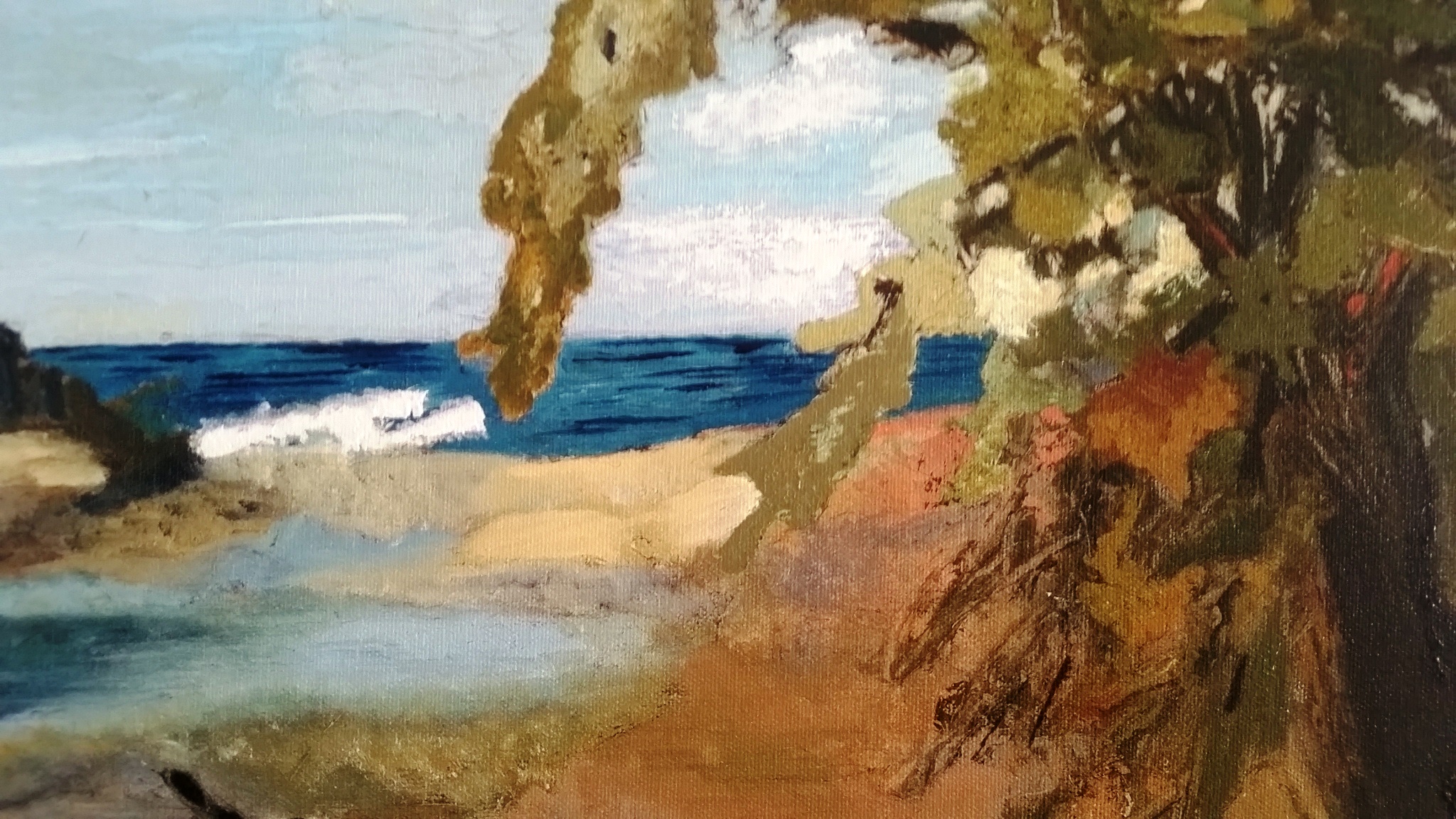
    winter shore

  1. Because we can. In many walks of life the cliché “just because you can doesn’t mean you should” rings true. Not here. We have a choice to forgive. What a powerful privilege. See numbers 1-6 and 8-10 for why we should make that choice. 
  1. It’s hard. We need to do the tough stuff. Facing something very painful and working through it to get to forgiveness takes effort and strength and courage. All good things to call upon. Grace and mercy aren’t too shabby, either.
     
    (If you’re like me, the absolute hardest person for me to forgive is…me. For some reason, offering forgiveness to others is much easier than letting myself off the hook. I think this is where a lot of us really need to up our game.) 

     
    summer shore

  1. Modeling forgiveness lets others see how it works. Seeing something in action can really be persuasive. I’m not one of those parents who tries to keep all conflict hidden from my kid. To me, that would be a false representation of life. He knows that sometimes people argue—and showing him how people forgive completes the lesson.
     
    ice breaker
  1. It embraces our mutual brokenness in a broken worldWe all sin, fall short, disappoint, hurt, mess up…all of us…continually. There’s no getting around it. It is our truth. Knowing that we can both offer forgiveness and be forgiven allows us to persevere and thrive in an imperfect world. Hope can continually bloom under the light of forgiveness.

Of course, this by far isn’t a definitive discourse on the merits of forgiveness, but I hope that you have found a little something here to remind you how key forgiveness is to a healthy life. And if you didn’t and instead feel like this has been a waste of your time, I hope you can find it in your heart to forgive me!


All photos are my own.
Please note that there may be advertisements below via WordPress.com.
The presence of these ads does not constitute endorsement of the information, services, or products found in them.

The Brushstrokes of Life

Divot in shin—knife drop, Easter Saturday, 2010. Forehead pockmark—head-butt on bathtub faucet, 1969. Knee “freckles”—torn meniscus, soccer game, 2012… I could go on and ON. My body is full of scars and imperfections. I’m guessing you might have a few, too.

We typically look at these kinds of marks on our bodies as flaws or eyesores. After all, they rarely, if ever, add beauty to a person’s body, right? Stretch marks anyone? But what if we considered them not as imperfections, but brushstrokes that come together to help create the work of art that we are?


brushes


In a way, each mark that we acquire through our lives is a mark of our journey. They may not necessarily “represent” anything in particular, but they are a part of us. Maybe if we cast a kinder eye on those scars we would be better able to see them as an essential part of ourselves.

You don’t get through life unscathed.

And what about the scars below the skin—the ones that we carry on our hearts? Maybe your heart is marked with the death of a loved one. Maybe there are rejections you’ve suffered in love, work, or friendship. Maybe you’ve gone through a trauma that you have yet to give voice to. Maybe you have been treated unfairly or abused. Maybe you’re battling an illness. Maybe you’ve failed in some capacity. Maybe many or all of these things have touched you in some way.

These kinds of hurts definitely leave their mark. Some much deeper than others, but a mark nonetheless. And while it is critical to work toward healing in every way we can, we will never be able to bring the heart back to what it was before the scar.

We are forever changed.


art 1


But what if we also look at these scars as brushstrokes on the canvas of our lives? Each mark helping to form who we are? Though this perspective doesn’t take away the pain of the “heart scar,” it may help us to see that there is meaning within it.

I know some of my heart scars have equipped me to be a better person. I’m using the term “better” here in a relative sense—as in what I believe is important. Compassion and empathy are important to me, and my heart scars have led me to be more compassionate and empathetic.

Of course, hindsight helps me understand this. For example, my dad died of cancer when I was 21. Obviously, that is a major heart scar with many facets to it—some obvious and some not so obvious. But I had no idea when I was going through it how many times I would be able to be there for a friend who was going through the loss of a loved one or battling cancer. Simply being there with some firsthand understanding ended up being of some comfort to several people in my life since then, and I am grateful for that. It means that the loss of my dad and the pain that is left behind from it in some way served a purpose. The heart scar has meaning.


art 2


And since we know we won’t get through life unscathed—either physically or emotionally—it helps to recognize that those brushstrokes are helping us become works of art even through the pain.

At least it helps to know for me.

In my mind’s eye, when I stand back and see how my “brushstrokes” are coming together, I see the work in progress that I am. I see how many things, when observed in isolation—can only be seen as ugly or painful—but with some perspective, are essential to the creation of the work as a whole.

Though some days my life canvas looks like something painted by Pollock or Picasso when I’d prefer Degas or Hopper, it is a work of art nonetheless. And that work of art is me.

I wonder what challenging brushstrokes you’ve been through…and what does your painting look like?


All photos are my own.
Please note that there may be advertisements below via WordPress.com.
The presence of these ads does not constitute endorsement of the information, services, or products found in them.

Only Light Can Do That

Darkness cannot drive out darkness;
only light can do that.
Hate cannot drive out hate;
only love can do that.

Dr. Martin Luther King Jr.
 Strength To Love, 1963


The recent deadly attacks in Paris by terrorists against the satirical magazine Charlie Hebdo have much of the world on edge. On this Martin Luther King Jr. Day, I can’t help but wonder what the Rev. Dr. King would have to say about it all. Though we have made strides in fulfilling his “dream,” we have a very long way to go.

When I think of Dr. King, I think of his faith, hope, perseverance, love, wisdom, compassion, grace, and peace–and his work for justice and freedom for all.

I don’t believe we can move forward by staying silent, and as a former English teacher, you can bet your sweet bippy that I am not a fan of book banning. Censorship does not make “bad” go away–it just makes it find other ways to come out. And who exactly has the final word on what “bad” is anyway? To this day, books like To Kill a Mockingbird are banned from many schools.

I absolutely loved teaching Mockingbird in major part because of the fact that it offered opportunities for students to discuss some very important issues–discussions that often led to understanding the world and each other a little better. That’s what brings the light.

So on this day, I want to share a post I wrote around a year ago. (It was back when I posted on “Frabjous Friday,” which I no longer do because of time constraints.) Though my story doesn’t directly deal with civil rights, I believe Dr. King would appreciate it because those students felt what it was like to have a voice. And as he said, our lives begin to end the day we become silent about things that matter.

Thank you, Dr. King.


TKAM


The Day Harper Lee Wrote Back


Originally posted January 3, 2014.


The idea behind my Frabjous Friday posts is to share something joyful–or at least something that will make you smile. Today’s post was a very joyful moment in my life, and I’d like to share it with you. It happened 17 years ago almost to the day. It’s a little longer than my typical Friday post, but I hope you’ll find it worth your time.

Back when I taught high school English, my freshman class read To Kill a Mockingbird as one of our core novels. I loved that book as a student, and I treasured it as a teacher. So many layers to explore and think about all delivered in a wonderfully descriptive and even suspenseful way. There was no greater joy for me as a teacher than to see a student come alive within the pages of a book, and Ms. Lee’s one and only published novel kindled that time and again.

One of the activities that we did after reading it was to send notes to Harper Lee. The first time I did this and told the kids we were really going to send the letters, they were stunned. Really? In junior high they did the activity frequently, and it was just for “pretend,” as they called it. I told them why wouldn’t we send them when she is still around to receive them? This made them take their own words a little more seriously. A real author–one whose work many had grown to care for–would be reading it, after all!

I showed them all how I put their letters into a big manila envelope and addressed it to “Harper Lee, Monroeville, Alabama” with the proper zip code. Since Harper Lee was a recluse, this was the best I could do. I figured the town knew her whereabouts.

The first year’s letter writing experience had been positive enough that I did it again the next year, with much the same response from the students. As a teacher, it was satisfying to know that the kids realized their words were being delivered. It mattered.

I just didn’t know it mattered to Ms. Lee, too.

One day, a few weeks after the second batch of letters had been sent, I went to my teacher’s mailbox. Inside was an envelope the size of a thank you card, and I could see that the return address had “Monroeville, AL” written on it. My hands started to tremble. Was it possible that one of the nation’s great authors had written back to us?

Why, yes. Yes she did.


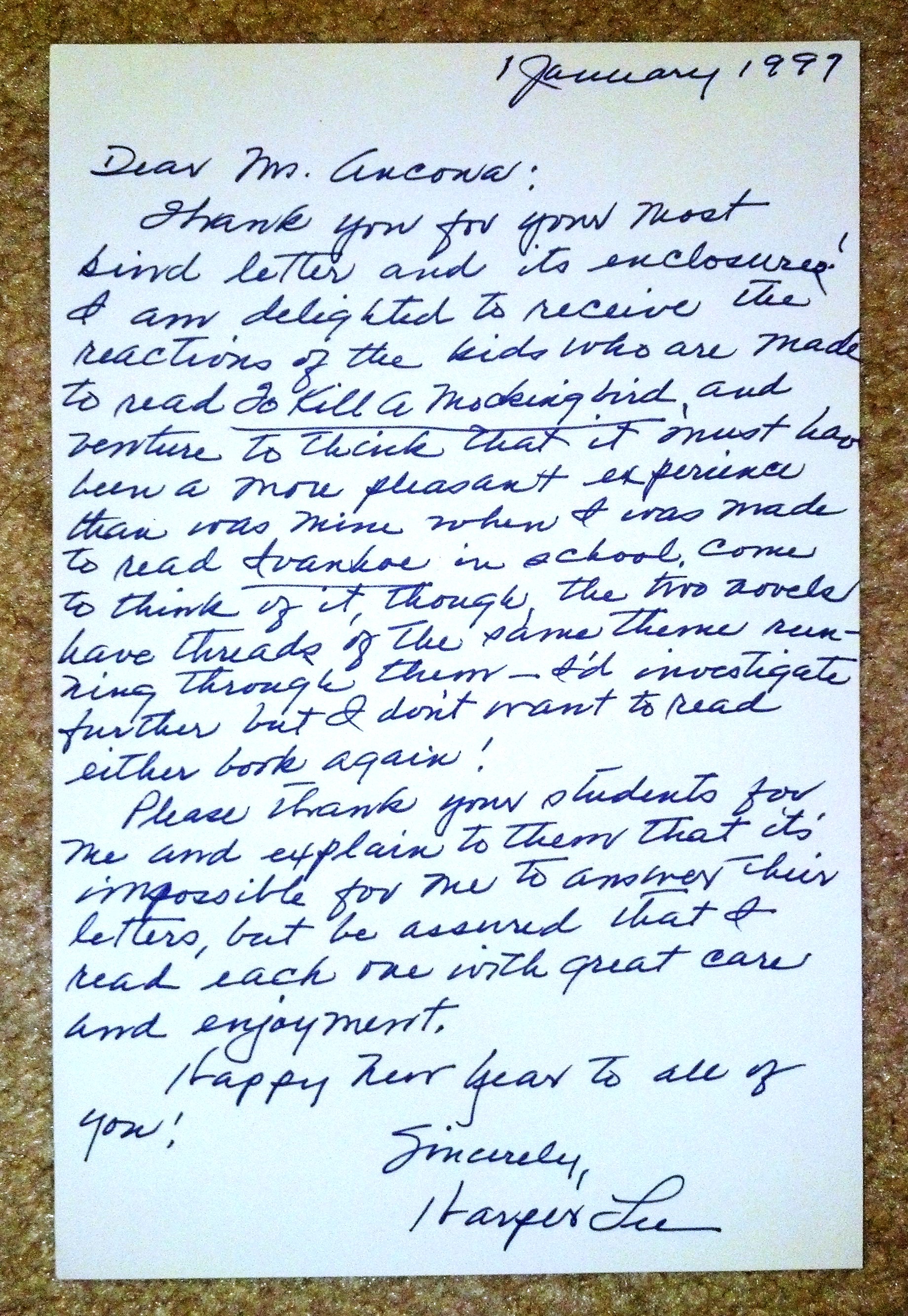
Harper


I couldn’t believe it. How kind she was to let my students (and me!) know that she had read every letter with “great care and enjoyment.” My students were giddy with excitement–and it’s not often you see 14-year-olds giddy about anything. It was a tremendous validation for them–and for me as an educator. Words matter. Thought matters. Kindness matters.

I hope my former students think back on that experience with joy. I know I do. Ms. Lee’s letter still graces my office and makes me smile every time I see it.

17 years ago Harper Lee wished me and my students a Happy New Year. How cool is that?

Happy New Year to all of you, too!

“You never really understand a person until you consider things from his point of view–until you climb inside of his skin and walk around in it.” ~Atticus Finch


All photos are my own.
Please note that there may be advertisements below via WordPress.com.
The presence of these ads does not constitute endorsement of the information, services, or products found in them.

The Rhythm of Days

This past week began with a baptism and celebration of a friend’s baby and ended with a funeral for another friend. From one end of the spectrum to another…and it reminded me of both the beauty and pain of life.

When my son was a baby, a friend gave me the children’s book Let Me Hold You Longer by Karen Kingsbury. It’s a beautifully sweet picture book that reminds parents to not only enjoy the “firsts” of their little ones, but also the “lasts,” too. I could never (still can’t) get through it without tears. “Mom, why are you crying? Is something wrong?” my little man would ask as he looked up at me with big eyes, wondering why the tears were welling as I read to him. Through my sniffles, I would reassure him that all was well…but I could already feel the time slipping away.


???????????????????????????????


And that is indeed life. We have certain things in our lives that happen to a rhythm, but then one day the rhythm changes, and what was routine is no longer. Aware of this, I really do strive to be mindful of “lasts” with my son. Like when he grew to the age where carrying him was getting harder and harder, it would flash across my mind, “Could this be the last time?” I didn’t want to take anything for granted; I wanted to tuck the memory away in my heart for safekeeping.

But even with that mindfulness, there is no way to know the lasts for most things. I didn’t know the last time my son would snuggle on my lap and really fit my lap. Or the last time he would say “brefkist” instead of “breakfast.” And I doubt I’ll know the last time he willingly holds my hand as a boy—though there will most likely come the day he will hold my hand as a man in order to make sure his old mom doesn’t fall.

Even though I know the lasts are coming, I simply don’t know when in order to be able to savor them in the moment.

Sometimes I recognize the lasts in hindsight. Having lost my dad at a relatively young age, I still sometimes reflect on the “lasts” of my time with him. The “lasts” I didn’t know were lasts until he was gone. Especially while looking at old photos, I find myself noting, “That was the last vacation we ever took,” or “this was the last birthday he celebrated…”

I wonder what would have changed if I knew it was a “last” for us? Certainly Kingsbury’s book title reflects the answer. Knowing would be so very bittersweet.

My heart hurts for my friend whose husband’s funeral I just attended. She had no idea of the lasts that she was experiencing. There was a familiar rhythm to life, and then, in an instant…he was gone. The “lasts” had been recorded without warning.

And now, along with the “lasts” she may eventually come to know, she will embark on a whole new journey of “firsts.” While many of the “firsts” are painful—like first holidays celebrated or returning to a favorite place filled with memories—the day will come when some firsts will offer the hope of better days, and new life rhythms will be created. The “lasts” are final, but the “firsts” can just keep coming. Thank God for that.

In the end, the firsts and lasts of life are only part of the story. Important parts—but not the only parts. They help us mark times of growth or change, but if they escape us, life goes on. The rest is the InBetween.

And so, for me, I must continually strive to be present for the InBetween, aware of the fragility of it all but savoring the beauty of it as best I can…Listening for the rhythms of life and dancing to the beat of each day’s song.


All photos are my own.
Please note that there may be advertisements below via WordPress.com.
The presence of these ads does not constitute endorsement of the information, services, or products found in them.

I Got This. Not. (Aka: Don’t Miss the Bus)

On my very first day of high school, I missed the bus.

Not that big of a deal, right? But it was. That one experience fed on my anxiety and planted a seed that grew a fear of missing any public transportation. Silly, I know, but very real. No matter if I’m catching a train, plane, or bus—until I’m actually on it, I have an internal twitch of dread that I will miss it.

All because of my first day of high school.

You see, I went to a grade school that had no buses, so this wasn’t just my first school bus to high school, but my first school bus ever.


IHC school bus
Bernd Moehle via Wikimedia Commons

Though starting in a new school is intimidating, I was pretty sure I was properly prepared. In particular, I studied my bus instructions—where the stop was and the number I needed to know. Bus 107. I got this, I thought. (Of course, that expression hadn’t been “invented” yet, so more likely I thought to myself, “Don’t be such a spaz” or “Duh,” but the sentiment was the same.)

That morning, my dad asked, “Are you sure about the bus?”

“Dad, I know what I’m doing…” (Uh-huh, sure you do.)

“Okay, great. Just let me know if you need anything.” (Don’t go far, Dad—I’m going to need to take you up on that offer shortly.)

And off I went.

There I was, standing on the corner I was supposed to, at the time I was supposed to, and within a few minutes, a bus drove by. The bus driver slowed down and called out, “Are you going to Lake Park?”

Isn’t this setting up to be a successful little scenario? After all, Lake Park was my high school! But there was something that wasn’t right. The bus number wasn’t 107, and I was supposed to be on bus 107. My mind quickly jumped to a conclusion—our school had two different campuses—East and West, and my campus was East so this bus must be headed to West! (Not exactly an Einstein in the making since classes at West started at least a half hour earlier than East.)

“Yes, but East!” I shouted back to him. He gave me a look of knitted brows and gestured with his hand up to his ear letting me know he couldn’t quite hear over the engine, so I just waved at him to keep going…he smiled, shrugged, and off he drove.


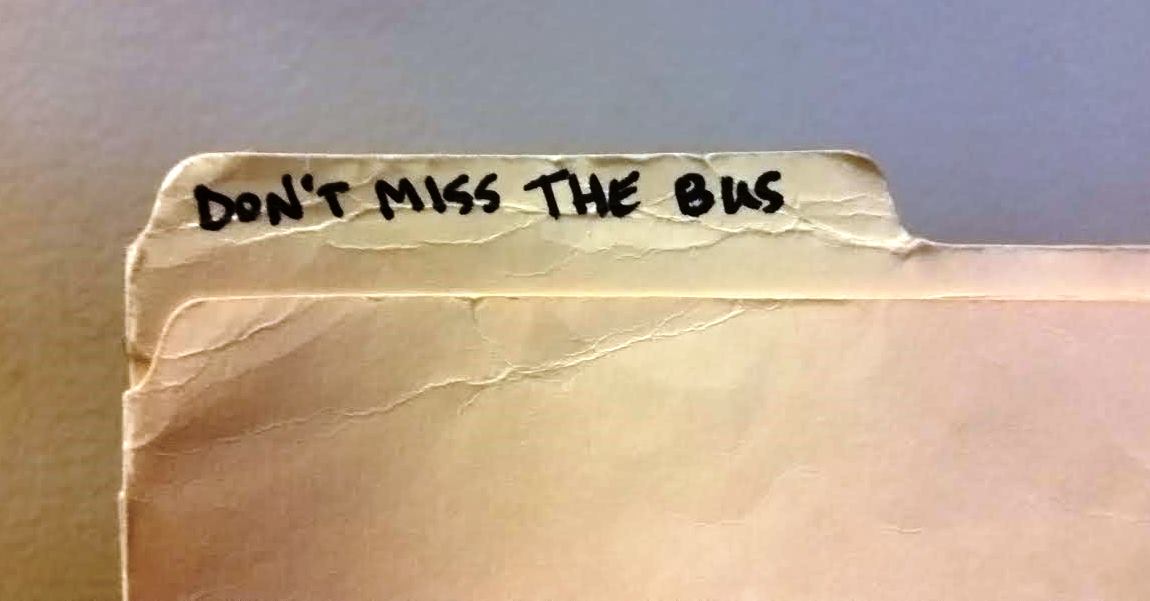
file


And then I waited. And waited…And waited.

No more buses came down the street.

Time was running out, and I was risking being late to my first day of high school. I walked back home with tears welling up…How was high school going to be okay if I couldn’t even successfully catch the bus?! I felt remarkably stupid.

I walked into my house where my dad hadn’t yet left for work and was surprised to see me (since I knew what I was doing and all)—by that point I was pretty much sobbing. “Babe, what’s wrong?!”

“I missed the bus, Dad! I couldn’t even get on the bus! I don’t know what happened…some bus came by but it was the wrong num…” he cut me off with a “shhh” and a hug, reassuring me that everything was going to be all right. He’d drive me today, and we would figure out where the problem was for tomorrow.


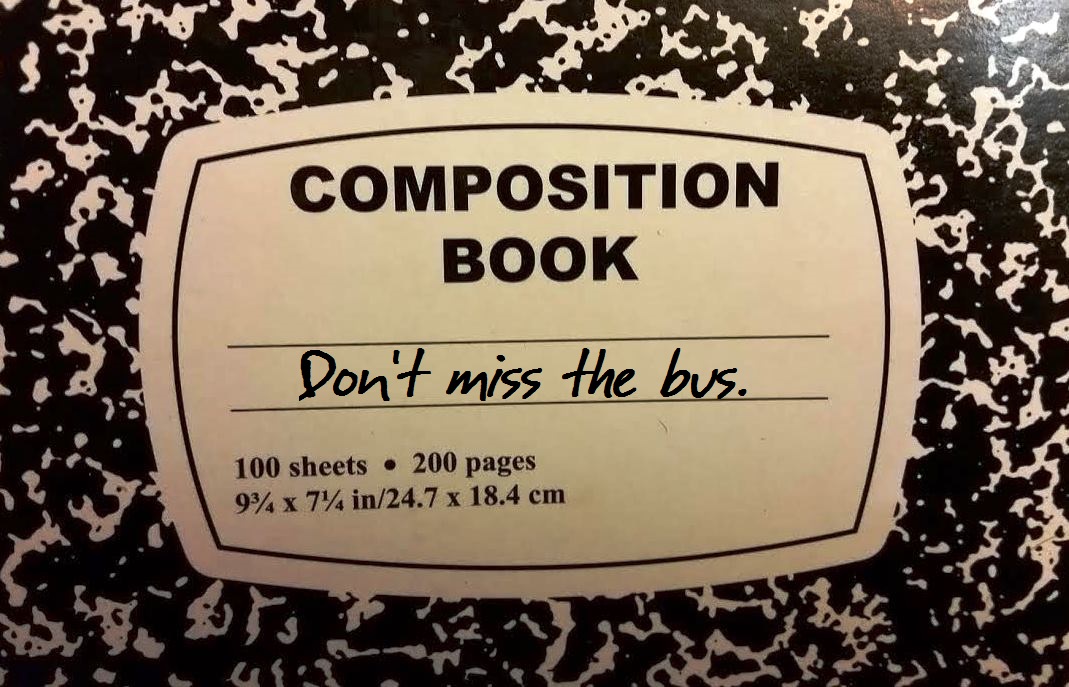
comp


And that’s exactly what we did. I was on time to school (thank God bus routes are long), and other than that, my high school career began without a hitch. But not without an emotional scar.

Do you want to know the answer to the bus mystery? It’s simple: I thought I was supposed to get on bus 107, but I was really scheduled for route 107. Which is exactly the route that the kind bus driver was driving when he called out to me. As a newbie, I didn’t know that the number of the actual bus meant nothing—but the route number in the window sure did.

Maybe if I would have reviewed the information with my dad when he asked, he could have caught my mistake. Maybe if I wouldn’t have been so quick to think I knew the answer when the bus driver was talking to me and instead asked for help, I would have been on my merry way. Maybe if I wasn’t so ready to show everyone that I knew what I was doing…I might have actually learned what I really needed to know.


yellow post it note with tack isolated on white


Instead, throughout high school I had countless anxiety dreams of missing the bus, or catching the bus but seeing my backpack left behind on the curb, or running after the bus that was going too fast for me to catch, or trying to get on the bus but the bus doors wouldn’t open…you get the idea. The anxiety dragon feasts on these kinds of episodes.

I never missed the bus after that day, but it only took that one time to engrain in me the knee-jerk fear of it ever happening again. It’s a fear that stays with me still today. (Ask my husband how fun it is.)

Of course, as with all trials that come our way, it’s best to try and learn something from them. Yes, I did get a lifetime of public transportation anxiety, but I realized, too, that I shouldn’t be so quick to think I know what I’m talking about—an ever-evolving lesson for me.

Yes, I missed the bus that day in more ways than one, but you better believe it taught me to know life’s route numbers!