It’s Time to Move Mountains

My thoughts here are a bit passionately swirled, so please bear with me.

When people talk when they don’t know what they’re talking about—and not just talk, but judge—I have a problem with that. A big problem. I’ve been feeling it pretty strongly this week with the death of Robin Williams.


Robin Williams (6451545105)
Photo by Eva Rinaldi, via Wikimedia Commons


I, along with so many others, was devastated to learn of Williams’ suicide. The one glimmer of hope I felt in his passing was that maybe it would shed better light on mental illness. After all, if a man seemingly so full of joy could take his own life…depression must be real, right? And, thankfully, I have heard some good conversations started because of it. But it’s also brought to light some stunningly insensitive opinions on the topic, as well—most notably (at least for me) the comments made by rocker Gene Simmons. Simmons has since tried to renege on his comments, but I find even those words exasperating.

That kind of stuff feels like a kick in the gut to me.

Back when I taught high school, I went to a student’s funeral who committed suicide. The semester had just started, so I didn’t really get to know her, but I really wish I had had the chance to…What I did see was that she was quiet, sweet, and thoughtful. And she totally mattered. The world lost out when she decided to leave it.

According to Mr. Simmons, though, she had some “dignity” when she killed herself. Granted, his comments are on the far end of the spectrum. While his words are easy for most of us to dismiss as outrageous, there are other responses that, while not so blatantly offensive, still show a lack of understanding when it comes to mental illness.

As I shared in Beautifully Broken, I cope with depression and anxiety. It runs in my family, and it has definitely left its mark. Though my struggles have not brought me to the brink, I understand how the thief that is depression can steal your hope and bring you to dark places that on a good day you could never imagine.

I don’t pretend to know much about depression, but at least I know I don’t know. And I do know that whatever other people are going through, my best response is to listen and care.

I know that mental illness is an illness…and not just people being electively “crazy.” I know that there are people who would never say “get over it” to someone who has cancer or heart disease, but don’t hold mental illness in the same category. Yet it is.

I’ve heard from the pulpit how if we just “turn toward God” we wouldn’t need prescription drugs. I’ve seen people forego seeking help because they have been told to pray harder. Read more scripture. And while I truly believe that all of those things are important, I know that that kind of attitude from members of the clergy does an injustice—and actual damage—to people who are suffering.

There is no shame in illnesses like Multiple Sclerosis or asthma—or any other type of illness—and there shouldn’t be in mental illness, either. Jesus healed all types of sickness with his loving touch. I missed the part in scripture where he dismisses anyone’s hurts or tells them to snap out of it.

Is it possible that some doctors wrongfully prescribe antidepressants to people? Why, yes—in fact I believe that myself because I know people who have had a two-minute chat with a doctor who was then ready to write a prescription. Is there more research to be done on the effectiveness of these kinds of medications? Absolutely. But that doesn’t negate the reality that for many people, these drugs are both a life-saver and giver.


meds


Meds work for some people and not for others. Psychotherapy works for some and not for others. Some people need both. For some, other treatments like electroshock therapy bring relief. Mental illness is not a one-trick pony.

And our response to it should not be to judge or to fix. Please don’t assume you know people’s brokenness—how they got broken, how they need to “fix” it, or what they are doing “wrong.”

As with all the rest of life, if we just tried to understand and care for one another…to have empathy for another’s experience…we could move mountains.

So let’s push to remove the stigma of mental illness. Let’s make it so that people who need help aren’t afraid of being seen as “less than” and instead feel safe to seek help as soon as they realize they need it. Let’s not judge the battles of those whose shoes we have not walked in. Let’s understand that this type of illness can hit anyone at any time, and the sooner we make these kinds of changes, the better for the whole world.

Let’s move mountains.


If you or someone you know is considering suicide, please seek help immediately. Don’t question whether or not you should seek help—just do it. The American Suicide Prevention Hotline can be found here, and here is a list of international suicide crisis hotlines

My Season of beLonging

baseballIn the summer of ’78, I betrayed myself. I sold my soul in an effort to fit in.

It was a scar that was forgotten until recently when an old friend posted a pic on Facebook for “ThrowBack Thursday.”

The distinction between being a Chicago White Sox or a Cubs fan is a strong one in my world. Those who say they are fans of both really aren’t baseball fans, in my opinion.

“Cubs or Sox?” was the second question I asked my future husband on our first date. Colors run deep (and good guys wear black). And while the current state of my life and baseball make it harder for me to really follow my team with any depth—it’s still a part of my core.

I grew up a Sox fan in a suburb of Chicago where that meant I was in a minority. I didn’t care—I wore (and wear) the distinction proudly. But in the summer of ’78, I pretended to be a Cubs fan in order to fit in better with my extended family.

The Evidence
The Evidence

I hid my Sox gear and started to watch Cubs games. I had a photo of Bill Buckner on my wall. I even got my hands on a Cubs shirt and wore it–which is what I was wearing in the Facebook photo.

I did all of this because my cousins were Cubs fans, and as we spent more time than usual with them that summer, I desperately longed to fit in.

We are social creatures. Whether introvert or extrovert, the need to connect is strong. For me, it was strong enough to betray what I knew was my truth in order to be accepted as “one of us” by others. As someone who values loyalty above so much else, it hurts to admit.

The betrayal lasted a season before I returned to my senses, and as the years went by, I buried the memory of my weakness. But the Facebook post brought back those memories and opened the door to my infidelity.

Let’s just say I’ve heard about it from a few people.

As a parent, I’ve had more than one conversation with my son (who is coincidentally the same age that I was when this story took place) about the difference between fitting in and belonging. I’ve shared with him how fitting in means altering yourself to be accepted, while belonging means being accepted for who you already are. I’ve shared how I believe this is a struggle throughout most people’s lives in one way or another, and the ultimate goal is to be yourself and then find where you truly belong, while accepting and loving others for their truths, too. (Unless they’re Cubs fans. Just kidding. Oh, shut up. Why don’t you go and think back fondly on your 1908 World Series win?)


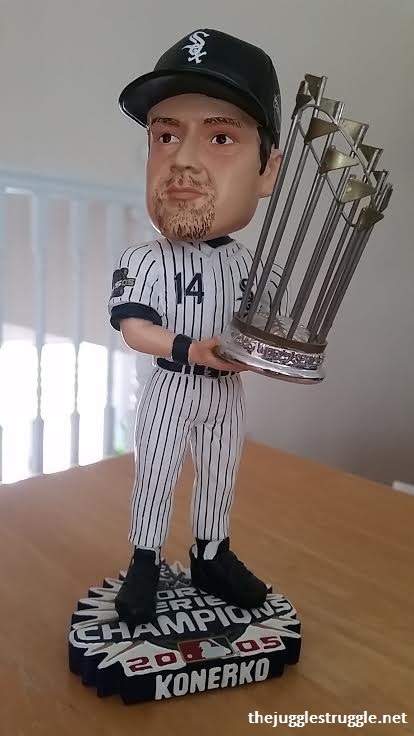
Participating in the World Series 2005 Championship Celebration


So, yeah…our team loyalties are strong.


Sox celebration
Did I mention the White Sox were World Series Champs in 2005?


When my son saw the photo on Facebook he was slack jawed and confused. “Mom!?! What is that?!”   

As you can see from the photo below, he has been a Sox fan from the start.


my little Sox fan


And so I had to cop to it and tell him my truth of the summer of ‘78. And it was a funny but teachable moment that reinforced the very point about desiring to belong rather than fit in, and how peer pressure to conform can lead you to compromising your values.

As I wrote in one of my Facebook comments on the photo, I just talked to my son about this—and how peer pressure can cause you to make HORRIBLE choices!!! (Choosing to masquerade as a Cubs fan is just slightly better than choosing crack cocaine!)

Yes, it is a topic that is non-threatening and (somewhat!) light-hearted, but he got the point that altering yourself from what you know is your truth in order to be accepted by others can lead you to choices that can run the gamut from embarrassment to shame and regret—and sometimes even worse.

While I am not about to fool myself into thinking that this is a “one and done” lesson where he will forever make the right choices, I do think it was a memorable example to help drive the message a little deeper. Maybe my season of betrayal had some purpose after all.

We all long to belong—to find that place where we are loved simply for who we are. Where our passions and quirks are accepted, and we are embraced—flaws and all. Where our metaphorical hair can be let down, and not only is it okay, but we have support to help us comb through the tangles.

At the very least, I believe my son knows that one of those places for him is right here with his family where, no matter what, he is loved thoroughly and unconditionally—even if one day he does come home…wearing Cubby blue.


paulie


And…Action!

ballsWhen I was 9, I learned how to juggle. When I was a senior in high school, I won the P.E. Student of the Year based primarily on the fact that in our unit on Circus Stunts (oh yes, we did) I could juggle. (Let’s just say I took a little ribbing about that from my all-state wrestler friend.)

Juggling for me is like riding a bike—I can go a long time without doing it, but I never forget how. That’s why when I heard of a casting call for jugglers for the web series Tough Season 2*, I had the nerve to apply for it.

And I was chosen. To juggle. On camera.

Me.

And here is my story of the day I became a professional juggler.

I was told to bring “hippie attire” because it was a scene where a bunch of free spirits are at a juggling retreat. I raided my closet and found whatever might possibly be considered such, and off I went.

As soon as I arrived, I immediately feared I wasn’t worthy of being there. Walking behind another extra with a rolling suitcase, I commented, “Wow, you brought a suitcase…” to which he responded, “This ain’t my first rodeo.”

It was for me.

I stood in line for wardrobe between an older man and a young woman who recognized each other from a juggling event they both attended last year.

Oh, boy, was I out of my league.

The girl had a suitcase full of juggling clubs and hippie wear, and there I was with just my three balls.

I was a juggling fraud. What was I thinking when I said yes to this?

And if that wasn’t welcoming enough, there was Mr. Professional Extra who felt compelled to tell me how things are NORMally done. Over and over again. And then one more time, just in case.

The wardrobe woman looked my duds over and quickly decided I needed more, so she added a shimmering jacket, boa, and free flowing skirt to my top, and I was deemed acceptable.


my "free spirit" outfit
practicing in my “free spirit” outfit


Though my clothes were given a thumbs up, I still wondered if I had what it took. The casting agent told me all levels of ability were welcomed, but it’s amazing how quickly I was ready to discount myself.

By the time we walked out to the set, the jugglers had all introduced ourselves and broken the ice with a few laughs here and there. We all wondered how it would be when the cameras were rolling. It was good to know I wasn’t alone in my doubt.

And then we started to practice…and…I wasn’t the worst. I wasn’t near the best, but…I had every right to be there.


practice
some of the other free spirits…


Now there was just this little hurdle left of being able to juggle after the word “action!” was shouted.

The actor who played the juggling teacher was to say, “Remember—the first rule of juggling is not to drop the balls!” while we all juggled our little hearts out.

Of course, the line was delivered, and inevitably one of us would drop the balls. Not that that was a deal breaker—because we were supposed to be at a retreat learning—but it was funny how we spazzed out just because we knew the cameras were rolling.

How many things are like that in life? Where you are able to do something just fine, and then you’re under a little pressure and suddenly you lose the control you thought you had?

It was as though my day as a “real” juggler was like a living metaphor for this blog—I can juggle. I will drop the balls. And then I will pick them up and start over again. And it’s the same for everyone else—no matter how skilled you are. We all can feel the pressure, make mistakes, and then choose to give up or pick up and begin again.


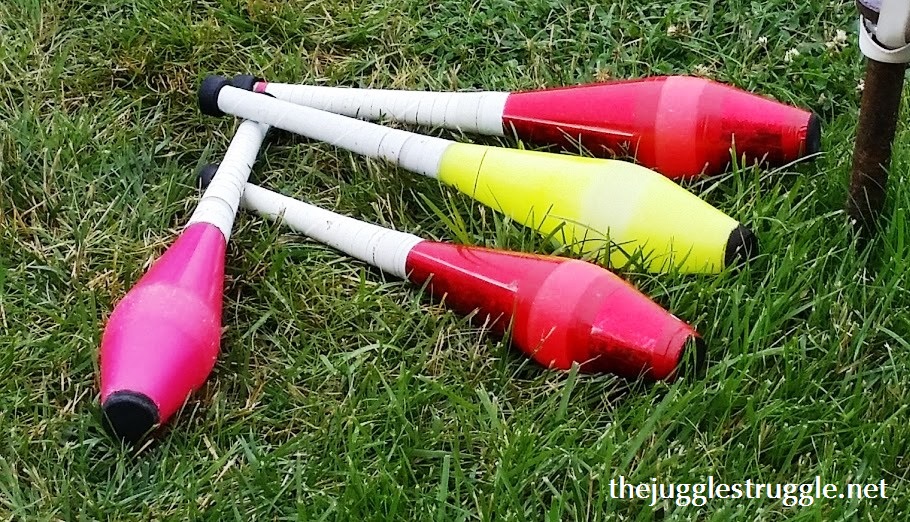
clubs


Sometimes trying too hard not to fail results in exactly that: failure.

Accepting that there will be the inevitable dropped ball here and there makes me a better juggler.

Before I knew it, the scene was over and we were done. We still had to hang out and wait…and wait…to see if we might be needed, but the overall experience was really a whole lot of fun.


action
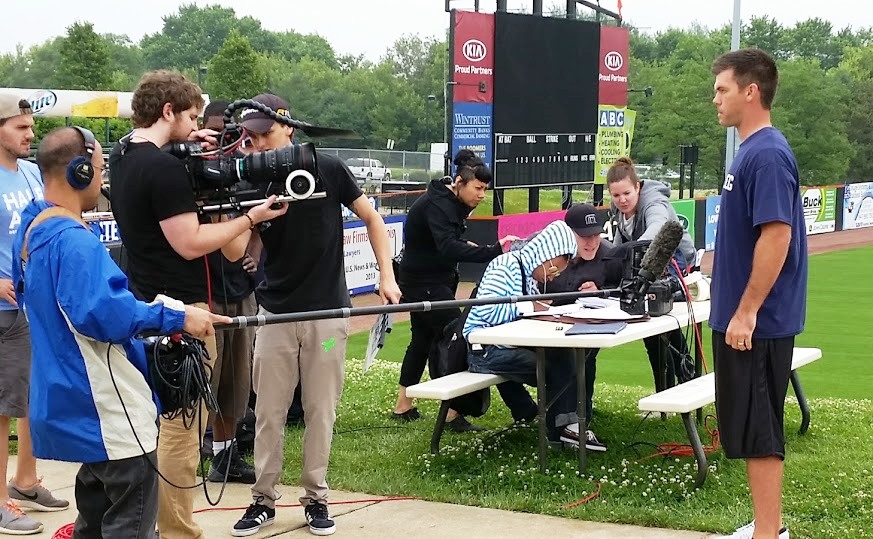
shooting another scene


I not only made some nice pocket money, but I learned I did have what it takes after all, and I had a great reminder to share with you here—that the juggling life we lead will always have dropped balls, and though it may get harder when life shouts, “Action!” we need to shut down the doubts and focus—and we will get the job done.

And, ultimately…knowing how to pick up the balls and keep going is maybe the most important skill of all.


*The web series Tough Season is in its second season and is a production of the NFL, the Onion, and Lenovo. I’ve watched some episodes and found it to be amusing. If you’re interested, check it out on IMBD and The Onion.

Do You Remember When That Guy Did That Thing?

I was standing in line for the deli at my local grocery store when I thought I saw a familiar face and wondered if she was someone I knew. My mind immediately went to its tattered mental Rolodex of names and faces…and I drew a big, fat blank. But I swore I knew her in some way.

Just then she swiveled her head my way, smiled and said, “Hi!” Validation! I DO know her…but…how? “Hey! How are you?” I responded, hoping she might say something that would give me a little more context to work with. No luck.


rolodex page


I HATE that feeling.

I hate knowing that I should know something that I don’t.

I hate forgetting.

I am happy to report that hours later it dawned on me how I knew this young woman. My frayed Rolodex found the right page.

A minor mental victory.

I feel like my memory is challenging me more and more of late, and it’s very frustrating and disheartening. Sometimes even scary. As someone who values experiences as the biggest treasures to accumulate in life, this threatens my booty, so to speak.

I don’t want the memory pirates storming my ship and stealing my goods.


Hey, lady--give me all your booty! Rrrrrrrrrrr!
Hey, lady–give me all your booty! Rrrrrrrrrrr!


Though memory loss is a worry of mine, I hang onto a lesson I learned long ago that really made sense to me—courtesy of Marilyn Vos Savant’s Q&A column in Parade Magazine, of all places.

While I didn’t save the column, I remember it well. The questioner wanted to know what value there was to seeing a play—or reading a book or anything along those lines—if you eventually forget the content of what you saw or read. Why bother if the memory fades? Does it still have worth? Does it matter?

Vos Savant’s answer drew a parallel to having a friend in kindergarten. She said that while most adults no longer remember the specifics of that friendship—maybe not even the name of the friend—isn’t it still important? Wasn’t it of value at the time and still of value now because it helped shape us into who we grew to be?

Though we may forget, it still matters.

I used this parallel throughout my teaching years when students would ask similar questions as to the value of reading. Once you’ve been touched by something, you never see the world in exactly the same way, I would tell them.

When we pay attention and let something soak in a little, it helps to shape and shade our perspective—maybe just a teensy bit—even if we can no longer bring it to the “front” of our brains, as I like to call it.


yellow post it note with tack isolated on white


That’s what I comfort myself with when I look at a book on my shelf and barely remember the story or know I’ve seen a movie but can only recall that Morgan Freeman was in it…My memory may be cloudy, but each experience or creative work that I “let in” leaves a mark on me, even if only slight—it still touched me.

That question to Vos Savant was posed before today’s fractured world of multi-tab pages and content coming at us from all directions, and we don’t do our memory any favors by consuming experiences in that way, in my opinion. There is little time for anything to sink into our brains with scattershot. For me, nothing beats some quiet time with a book or a darkened theater about to light up with the hoisting of the curtain. Push away the distractions and engage.


Red Theater Curtain


Still…even with raising the odds like that, most likely the plotline will grow dim and eventually I will just remember that I really liked (or didn’t like) the experience.

And I’m pretty sure it’s only going to get worse.

And that’ll have to be okay because there’s no way I want to live in a world where the only thing worth doing is that which I know I will never forget.

Because I won’t be doing much.

Just ask the girl in line at the deli counter.

The 9/6 Perspective

There are few times when a finger is pointed at you that it’s a good thing. Maybe you’re getting picked for a game of kickball or maybe you’ve raised your hand to be chosen for Let’s Make a Deal…but usually a finger aimed at you is a call-out of some sort.

Merriam Webster defines it as “the act of blaming someone for a problem instead of trying to fix or solve it; the act of making explicit and often unfair accusations of blame.”

I don’t know about you, but I’m getting exhausted with our culture of finger-pointing.

finger away

The polarization of society is something that really hurts my heart. Be it politics, religion—any number of social issues—people are so busy being adamantly, unwaveringly “right” and often just denigrating and denying the other side’s perspective, that our world is filled with hatred and so-called “righteousness.”

angry

When I taught high school English, one of the exercises I created to try to get students ready for a healthy debate was what I called the 9/6 Perspective. (I had to put the numbers in that order because calling it the 6/9 Perspective would cause too much giggling in a room full of teenagers).

The exercise was very simple. I wrote a figure boldly on a piece of paper, set it on a desk, and had all of the students circle around. Then I’d have two students stand on either side of the desk and tell me what they understood to be written on the paper. Without fail, one would say “a 9” and the other would say “a 6.”

9-6

I’d ask them “Are you sure?”

“I know my numbers, Ms. Ancona….”

“Of course I know a 6 when I see one…”

They were certain of the facts in front of them.

Then I would ask the rest of the class, “Well….who’s right?”

This would result in multiple voices speaking up…”They both are!” “It depends!” “If you’re on either side, it looks right!”

And so on…And eventually we would put words around the reality that each “side” saw their own truth—though the answers were completely different.

But it was still their truth.

How you see things matters. Where you’re coming from matters.

And the same goes for the other person.

Now don’t think I see myself as righteous in this respect—my own stances can be passionate for sure (ask me about equal rights, gun laws, or preaching love over law and be ready for an impassioned response)—but I know that when we shut the other side down with scorn and disdain, we simply grow farther apart when the real challenge is learning to live together.

Acknowledging and listening doesn’t mean agreeing or embracing. To listen to a 6 when you are a fervent 9 doesn’t mean they win or you give in, but it hopefully brings the debate to a healthier level where opinions are offered without calling names or spewing hatred.

The ease with which we can “plant our flags” and take stands on Facebook and Twitter has only made the situation worse. It always saddens me so when I see someone share their hatred of “the other side” in a post, and then see the “likes” and comments that follow.

unfollow

Before the ease of social media to share such things, the circles of disdain or hatred were smaller—or at least more under the radar. Now people share how others “disgust” them right after they post what a great time they had at the beach.

I think we can be better.

The person who sees a 9 when you know a 6 is right is still…a person. So while we can hold tight to our belief in 6, let’s not just be “disgusted” by the 9-seer. Let’s instead work toward what we might be able to do to get that person to walk over to our side of the desk and see the 6. Or maybe we need to do the very same to see their 9. And maybe when we’ve done that neither side will have budged a bit, but at least we might better understand why they believe in what they do.

Hand Reaching

I don’t mean to simplify life’s complex issues and people.

I know it’s not easy to extend grace when we are passionately entrenched on an issue…

…but I believe it’s what we are called to do.

And I very much believe in what the late, great Maya Angelou said time and again: “We are more alike than we are unalike.”

And if we look at one another that way rather than with contempt, we just might have ourselves a better world to live in.

Don’t Duck, Goose!

While I was in the bathroom yesterday morning, my son came knocking with a, “Mom! What do you feed a baby goose?!” Of course, I wondered why this question was of such urgency, and he informed me that there was a baby goose in our front yard.

I’m sure most moms know the next line of this script: “I’ll be right out,” I told him.


purple cropped_tag


In the couple minutes it took me to get to the yard, our little feathered friend had moved to the next yard over—which was being mowed by big landscaper mowers. My husband pointed me in the right direction, and I could already hear the little one’s cries over the white noise of the mower.

The landscaper knew we were trying to help the little bugger who, for simplicity’s sake, I will now refer to as Gus. Gus the Goose. He wasn’t quite a baby goose, though, more like a toddler or tween (beyond “gosling”—and I don’t mean Ryan—I am not up on my goose terminology). So the landscaper scooped up Gus, who was ensnared in some tall weeds, and gently set him down on our side of the fence.

Little Gus freaked.

He cried and ran around, well—for lack of an appropriate goose cliché—like a chicken with his head cut off.

No matter how slowly we moved or sweetly we cooed to him, he wanted nothing to do with us. The trouble was, he couldn’t fly, and unless he wanted to live in our yard until that day where his wings would lift him, he needed our help.

Unlike the wonderful nature shows filled with men and women who are extremely knowledgeable about wildlife, our little group’s best instinct was to offer water and some sunflower seeds along with some calming and reassuring voices.

Shockingly, Gus did not speak English. If we approached two steps, Gus frantically waddled seventy.

Eventually he resigned himself to his panic and fear and the seeming futility of it all. He waddled to the corner of our house by the glider door, nestled down, and ducked his little beak under a row of siding.


Vito and Gus


Our dog, Vito, as you can see, offered up a welcoming committee that Gus denied.

Here he was, needing help, having people want to help him, and all he could do was poop on our deck.

After he rested a few, we planned to pick him up and put him over our fence to set him free.

Still not speaking English, Gus freaked again.

He ran to the far corner of our yard, which has a compost hill, and climbed it. It wasn’t tall enough for him to make his escape, though, and while my husband moved in to scoop him up, poor Gus just jammed his head through the hole of the chain-link fence—as if maybe if he tried hard enough, his whole body would pop through.

He pretty much looked like a tween goose in the stockade.


Vito close_tag


But while he was in his own self-imposed stocks, my husband scooped him up and set him out of our yard.

Now he had his freedom, but…what would that mean? Little Gus on his own? My son and husband jumped the fence to follow Gus and make sure he could find his way to our nearby lake.

Within minutes, they came back and shared that they hadn’t made it to the lake because on the way, there was a group of adult geese that Gus ran into. It didn’t seem like his family, they said, because the geese didn’t exactly welcome him. No, first…they pecked him. I guess there is actual meaning behind the term “pecking order”! And once they pecked him a couple of times, they let him stay.

Now, I don’t speak Goose, just like Gus didn’t know English, but I’d like to think that that was their way of saying, “You can stick with us, just know your place,” because my guys said that after that, they all just kept on waddling.


bird feeder_tag


It was time to exhale. Our little Gus had found his adoptive family, or at least picked up with a group that might show him the way back home.

After all of the excitement, I got to thinking—how many times had I, like Gus, been unable to see the helping hand extended to me? How many times had I ducked my figurative beak into a wall and hoped the problem would go away?

Gus was offered help all along—from the kind landscaper to our clumsy family—but he was too scared to be able to trust the offer. How many times and in how many ways have I been running around squawking and essentially running away from help, just like our little goose?

Someday Gus will make it to flight stage. He will be able to soar and swoop and see the world in a whole new way. I doubt that he’ll remember that before he could fly, he needed a little lift from a family of strangers…but I’d like to think that somewhere in his birdbrain he does have a little less fear and a slightly better understanding of the world around him.

Just like me.